E-Flute vs B-Flute vs C-Flute: Corrugated Board Compared
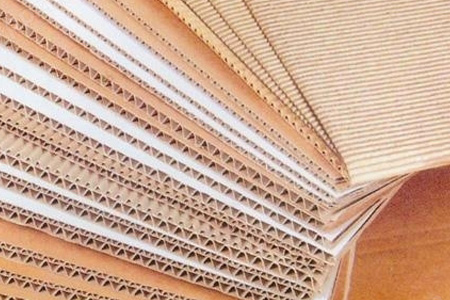
Most buyers know corrugated board comes in different “flutes” — the wavy middle layer that gives cardboard its name. Far fewer know what the flute actually changes, which is why orders come back with questions like “why does the same box feel different?” or “can we print photos on this?” The flute answers both. Choose the wrong one and you either pay for structure you don’t need or ship a box that crushes in the truck.
This is the engineering comparison behind our corrugated mailers and shippers — the same table our estimators work from, in buyer’s terms.
What a flute is, in fifteen seconds
Corrugated board is a sandwich: a wavy inner layer (the flute) glued between flat linerboards. The flute’s height and pitch — how tall and how tightly packed the waves are — set the board’s thickness, its crush resistance, its cushioning, and how flat a surface it offers for printing. Tight, short flutes give more wave crests per inch (stiffer per millimeter, better to print on); tall, sparse flutes give more vertical cushion (better stacking, rougher to print on).
The three standard flutes compared
| E-flute | B-flute | C-flute | |
|---|---|---|---|
| Thickness | 1.5 mm | 3 mm | 4 mm |
| Character | Thin, stiff, finest print | All-rounder, strong base | All-round shipping standard |
| Flat crush resistance | Best | Very good | Good |
| Vertical cushioning | Modest | Good | Better |
| Print surface | Excellent (offset-laminated) | Good (offset or flexo) | Fair (flute telegraphing) |
| Signature uses | Retail-ready, subscription, gift mailers | Die-cut retail packs, general e-commerce | Standard shipping cartons |
The family is actually bigger than three. A-flute (about 4.7 mm) is the original cushioning king — taller waves, fewer of them, superb vertical protection for fragile loads — and F-flute (under 1 mm) is the micro-flute behind small retail and cosmetics corrugated. Double-wall combinations bond two flutes for severe duty. E, B and C cover the overwhelming majority of e-commerce decisions, but the extremes are worth knowing when your product is unusual.
The counterintuitive fact hidden in this table: thinner E-flute resists flat crushing better than C-flute. More wave crests per inch spread a point load across more supports. That is why a 1.5 mm E-flute mailer protects a candle jar’s lid better than a chunky 4 mm C-flute box of the same footprint — cushioning against drops and resistance to crushing are different mechanical properties, and the flute trades between them.
The three decisions each flute answers
1. Retail shelf or shipping dock? E-flute exists because retail changed the game: boxes that sit on a shelf need offset-quality graphics and a thin, premium wall. Laminated E-flute — a litho label glued to the board — gives photographic print on corrugated, something direct printing on thicker flutes cannot match. B-flute splits the difference; C-flute is the classic brown shipping carton, where brand print is usually one or two flexo colors.
2. What loads the box — and what loads the pallet? Flat crush (a heavy parcel on top of yours) favors E and B. Vertical stacking strength down a pallet column favors C and double-wall. This is why e-commerce mailers standardize on E and B, while wholesale shipper cartons standardize on C.
3. How heavy is the product? Under ~1 kg with retail ambitions: E-flute. General e-commerce to a few kilograms: B-flute. Heavy, fragile, or palletized: C-flute — or BC double-wall (~7 mm, a B and C bonded together), which adds a second flute layer for severe stacking and long-haul vibration.
A note on double-wall and conversions
BC double-wall is not “a thicker C”. Bonding two flutes creates independent cushioning layers that handle combinations no single-wall board can — which is why it earns its freight weight on glass, ceramics and industrial parts even though it cannot be printed photographically. Conversely, brands moving from rigid boxes to corrugated often convert to offset-laminated E-flute: it keeps litho-quality graphics at a fraction of the weight and cost, with the trade-off documented in our rigid vs carton comparison.
Litho lamination: photographic print on corrugated
The “excellent print surface” rating on E-flute deserves an explanation, because it is really a process story. Direct flexo printing presses rubber plates onto the corrugated surface itself — fast and economical, but the flute texture shows through fine text and skin tones. Litho lamination instead prints full CMYK on a smooth liner sheet on the Heidelberg press — the same plates and color management as our folding cartons — then laminates that sheet onto the flute before die-cutting.
The result is folding-carton graphics on corrugated strength: gradients, small type, brand-critical Pantones. It is the standard for retail-ready E and B flute, and the reason an E-flute mailer can look like a gift box while surviving the courier. For high-volume, low-color shippers, direct flexo on C remains the cost king — which is why we quote both tracks on every mailer inquiry.
Sustainability, briefly
Thinner flutes use less fiber per box. E-flute mailers with water-based inks and mono-material construction are fully kerbside-recyclable, and the board itself typically carries high recycled content. If your brand reports on packaging sustainability, flute selection is one of the few decisions that improves both the footprint and the freight bill at once.
What we run, and what it means for your quote
All three flutes run on our automatic lines — flute laminating, die-cutting and gluing — with offset-laminated E and B produced on the Heidelberg lines for photographic quality. MOQ is 1,000 pieces per design, samples in 3–5 days, production in 10–15 days. The flute decision is confirmed on a physical sample before the run: crush it, drop it, load it like your customer will.
Not sure which flute your product needs? The companion question is freight — read Mailer Box Sizing for the dimensional-weight side, then send your product specs and the quote comes back with the flute recommendation and a tiered price inside 24 hours.