Custom Packaging Lead Time: From Quote to Doorstep
Custom packaging lead time is not one number printed beside a unit price. It is a chain of approvals and factory stages: quote, dieline, artwork, physical sample, mass production, quality inspection and delivery. A reliable launch plan separates the stages we can schedule precisely from the stages that depend on your approval speed, box construction and shipping route.
From our Dongguan factory floor, the biggest scheduling mistake is counting only mass-production days. A folding carton may take 10–15 days to produce after sample approval, but production cannot begin until the structure, artwork, material and finishes are signed off. The practical timeline starts when the inquiry contains enough information for an accurate quote.
The custom packaging timeline at a glance
These are the published factory windows for our six product lines. Sampling and production vary because a flat printed item does not pass through the same converting steps as a wrapped rigid box.
| Packaging type | MOQ | Physical sample | Mass production after approval |
|---|---|---|---|
| Custom printed boxes | 1,000 pcs | 3–5 days | 10–15 days |
| Corrugated mailers | 1,000 pcs | 3–5 days | 10–15 days |
| Paper bags | 1,000 pcs | 3–5 days | 10–15 days |
| Custom rigid boxes | 500 pcs | 5–7 days | 12–18 days |
| Wine and spirits boxes | 500 pcs | 5–7 days | 12–18 days |
| Tags, cards and bound print materials | 500 pcs | 2–5 days | 7–12 days |
The quote itself is returned within 24 hours when the inquiry includes the box size, quantity, material and finishing direction. Delivery comes after production and final inspection. Express, air, LCL sea freight, FCL sea freight and DDP door-to-door are available, but transit time is quoted against the destination and shipment plan rather than hidden inside the manufacturing window.
Stage 1: Inquiry and quote
A fast quote depends on a complete brief. The four inputs that matter first are:
- Finished internal or external dimensions
- Order quantity per design
- Preferred material or packaging structure
- Printing and finishing ideas
Add the destination postal code if you want freight included. That lets the quotation separate the box price from the delivery route and show a landed DDP option where appropriate. If you are not sure whether the product needs a folding carton, corrugated mailer or rigid box, send the product dimensions, weight and shipping path instead of guessing. Structure should follow what the package must survive.
The quote is also the point to declare a fixed launch date. Rush orders can be compressed by 30–40% when the press schedule allows, but that capacity must be confirmed before the order is treated as urgent. “Rush” is a production plan, not a promise added after artwork approval.
Stage 2: Dieline and artwork preparation
After the price and structure are accepted, our pre-press team prepares the structural dieline. Your designer places the artwork on that file, or our team can help with the layout. Print-ready files should use outlined fonts, 300 dpi images, CMYK color and PMS numbers for spot colors.
This stage has no honest universal day count because the buyer controls part of it. A clean artwork file can move directly into pre-flight checking. A file with missing fonts, low-resolution images, unclear finish layers or graphics crossing a fold needs revision before plates, dies or sample materials are prepared.
The fastest way to protect the schedule is to approve the structure before polishing decoration. Confirm dimensions, opening direction, product clearance and insert layout first. Then place the artwork on the final dieline. Our dieline artwork guide explains the file checks that prevent avoidable back-and-forth.
Stage 3: Physical pre-production sample
The sample is the decision gate between a digital plan and mass production. It uses the specified stock and finishes so you can check fit, color direction, opening behavior, insert retention and the physical feel of the box.
Sampling takes 3–5 days for folding cartons, corrugated mailers and paper bags. Rigid boxes and wine boxes take 5–7 days because their wrapped-board structures, inserts and closures require more converting steps. Tags, cards and bound print materials take 2–5 days. For confirmed orders, the pre-production sample is free; the buyer covers courier cost, typically $30–60 by DHL or FedEx.
Do not approve from photographs alone when fit or finish matters. Put the real product inside, open the package repeatedly, inspect folds and corners, and let the fulfillment team handle it. Mass production starts only after sample sign-off, so a careful sample review protects both quality and the calendar.
Stage 4: Mass production on the factory floor
Once the sample is approved, the production clock becomes much more predictable. The exact path depends on the construction, but our in-house sequence can include:
- CTP computer-to-plate preparation
- CMYK or PMS printing on Heidelberg CD102 or PM74 offset presses
- Automatic film lamination for matte, gloss or soft-touch surfaces
- Hot foil stamping, spot UV, embossing or debossing where specified
- Automatic die-cutting and creasing
- Automatic box gluing for folding cartons
- Flute lamination for offset-printed corrugated packaging
- V-grooving and visual-positioning wrapping for rigid boxes
Keeping these processes under one 5,000 m² roof reduces handoffs between unrelated suppliers. It also explains why construction changes the production window. Folding cartons move from printed sheet to finishing, die-cutting and gluing, so their standard window is 10–15 days after sample approval. Rigid and wine boxes add board preparation, wrapping, positioning and insert assembly, so their window is 12–18 days.
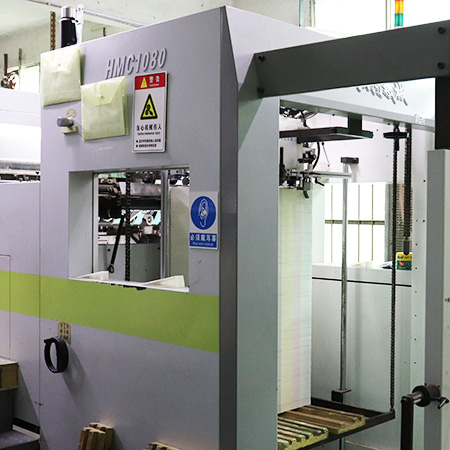
The factory photograph above shows the automatic die-cutting equipment used after printing and surface finishing. Computer-controlled cutting and creasing hold the structure consistently across the run. You can see the broader Heidelberg press and finishing fleet on our factory capabilities page.
Stage 5: Quality control and release
Production completion is not the same as shipment release. Each order moves through color management, in-line checks and a final AQL inspection. Automatic die-cutters and gluers monitor the converting run, while the final inspection checks a sample of finished goods before packing. Photo reports are provided before the order leaves the factory.
This stage matters to the schedule because finding a problem before freight booking is faster and safer than finding it after delivery. Brand-critical PMS colors can also be checked through printed drawdowns before mass production, keeping color approval earlier in the process rather than at the end.
Stage 6: Delivery to your door
After inspection and packing, the route depends on urgency, shipment volume and destination. We offer express, air freight, LCL or FCL sea freight, plus DDP door-to-door service. Under DDP, export clearance, duties and taxes are handled in the shipment plan so the goods arrive like a domestic delivery.
Because delivery time changes by route and destination, we do not turn it into a generic promise. Ask for the manufacturing window and freight option as separate lines. That gives you a useful schedule: a fixed factory plan plus a route-specific delivery plan. Our DDP shipping guide explains when door-to-door service is the simplest choice and when FOB or another term may fit better.
How to shorten packaging lead time without creating risk
The safest schedule gains happen before the presses run:
- Send dimensions, quantity, material direction and destination in the first inquiry.
- Choose the structure before finalizing artwork.
- Mark foil, spot UV, embossing and other finishes on separate artwork layers.
- Supply a PMS number or physical color reference for brand-critical colors.
- Review the physical sample promptly and consolidate feedback into one revision list.
- Flag the launch deadline before ordering so press capacity and freight can be planned together.
Cutting the sample or final inspection is not the smart shortcut. The better shortcut is removing uncertainty from the brief and approvals.
Build your launch date backward
Start with the date the packaging must arrive, then work backward through route-specific delivery, final inspection, the correct production window and the physical sample. Add your own artwork and approval time as a separate block. That produces a schedule your team can manage instead of a single optimistic number nobody owns.
For a firm timeline, send the box size, quantity, material idea, finishes and destination. We will return a detailed quote within 24 hours, confirm the applicable sample and production windows, and quote the delivery route separately so you can plan from approval to doorstep.